
Quantum gates
Plan : FreeRun one or two qubits through a circuit, and watch superposition and entanglement form gate after gate.

Business problems
- Explain to a team what a qubit is without writing a formula on the whiteboard.
- Run a quantum computing awareness session with material you handle live.
Academic problems
- Teach 1- and 2-qubit gates, interference and phase kickback on minimal circuits.
- Connect entanglement to geometry: the Bloch sphere, the Hopf fibration of S³, and its generalisation to S⁷.
Methods & guarantees
- No measurement gate: the tab shows the probabilities you would get, without collapsing the state at random.
- Concurrence C = 2·|a·d − b·c| and the purity of each qubit, 1 − C²/2, recomputed live.
- Geometric reading of entanglement after Mosseri and Dandoloff (2001).
Build a circuit and play it gate after gate
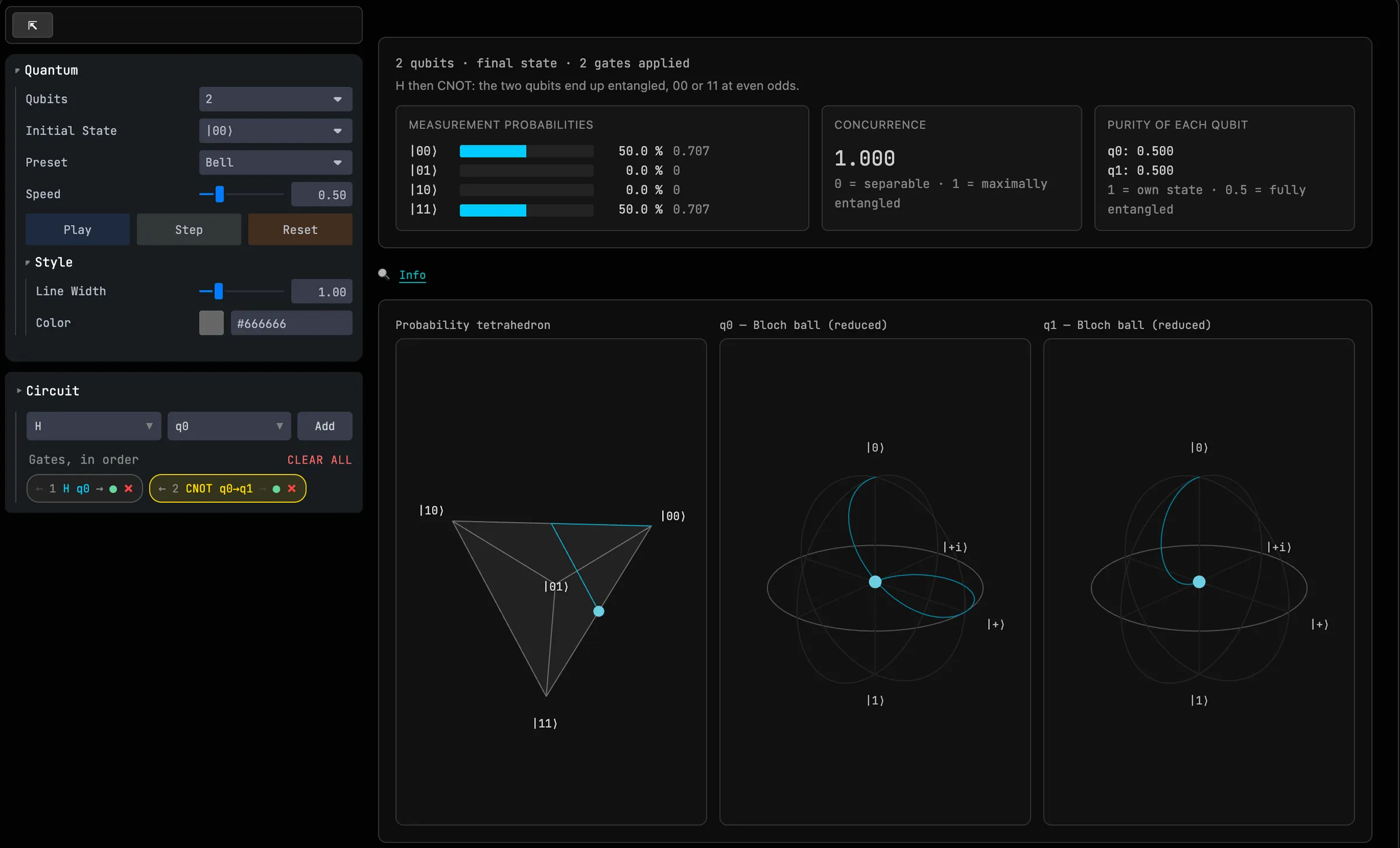
The Quantum tab is a teaching demonstrator: it needs no dataset. You pick the number of Qubits and the initial state, then add gates one by one, from X, H or RX to CNOT and SWAP. Four ready-made circuits serve as starting points: Bell, Interference H-H, Phase H-Z-H and Phase Kickback.
Play runs the circuit, Step advances by one gate. A gate does not jump from one state to the next: it applies gradually, like a rotation being carried out, and both numbers and 3D views follow the motion. Each gate can be switched off with one click, to compare a circuit with and without it.
Watch entanglement appear
Measurement probabilities gives, for each basis state, the probability of measuring it and its amplitude. Two states with identical bars can still differ by their phase: that is the whole point of Phase H-Z-H.
With two qubits, Concurrence measures entanglement, from 0 (each qubit has its own state) to 1 (maximal entanglement, as after Bell). The 3D views make it visible: in q0 — Bloch ball (reduced), each qubit's arrow shrinks toward the centre as entanglement rises.
An application of 4-dimensional hyperspheres
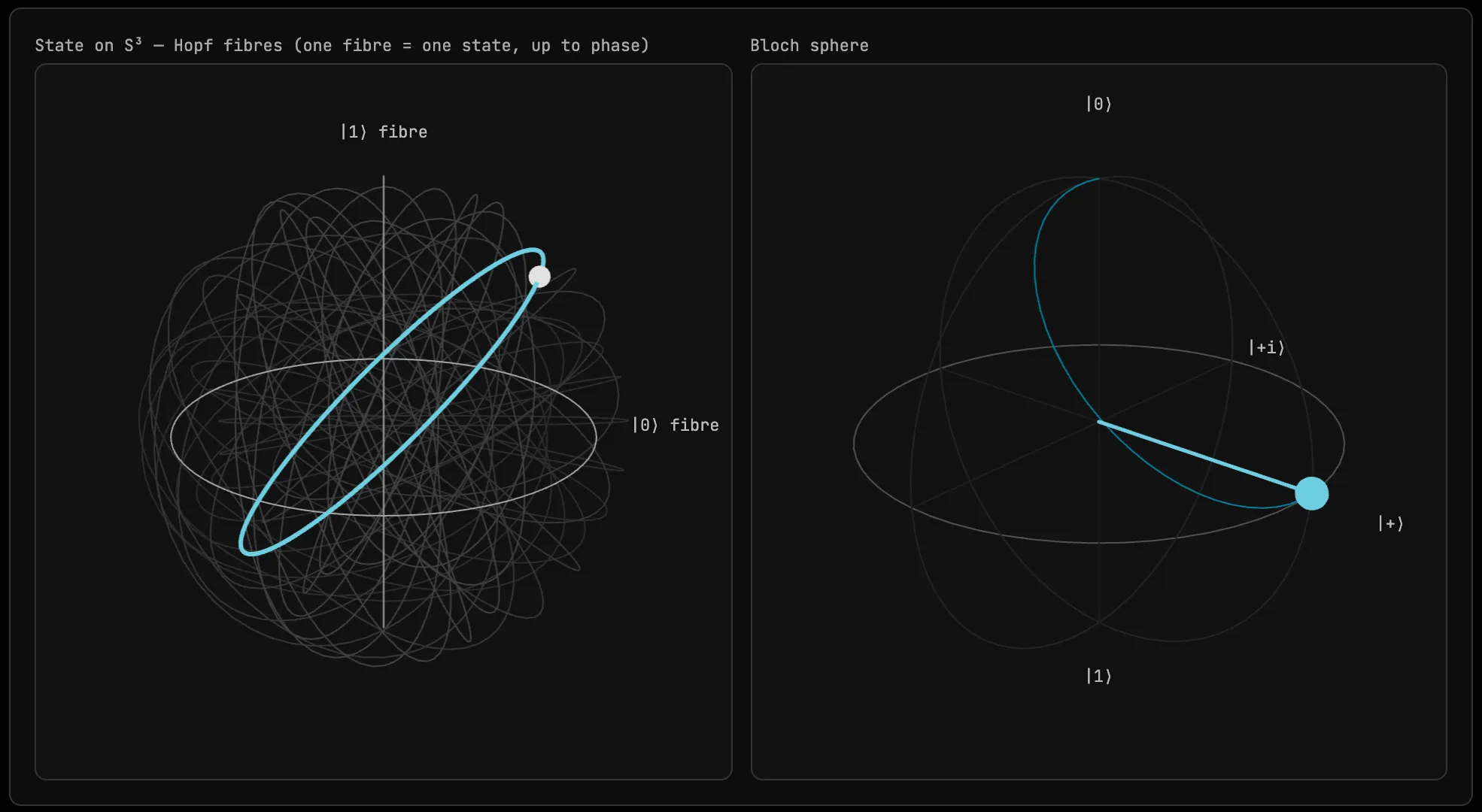
A normalised qubit is a point on the 3-sphere, the 4-dimensional hypersphere also found among the hypersolids. The State on S³ view shows it cut into Hopf fibres: each circle gathers the vectors that differ only by a global phase, hence one and the same physical state. The Bloch sphere next to it is its base.
With two qubits, the state lives on the 7-sphere, whose Hopf fibration has a 4-sphere as its base. Its coordinates are the reduced Bloch vector and the concurrence: the geometry already tells everything about entanglement.
Try it on your own data
Everything runs in your browser: your data never leaves it.
Open TetrachoreUpdated 7 November 2026